

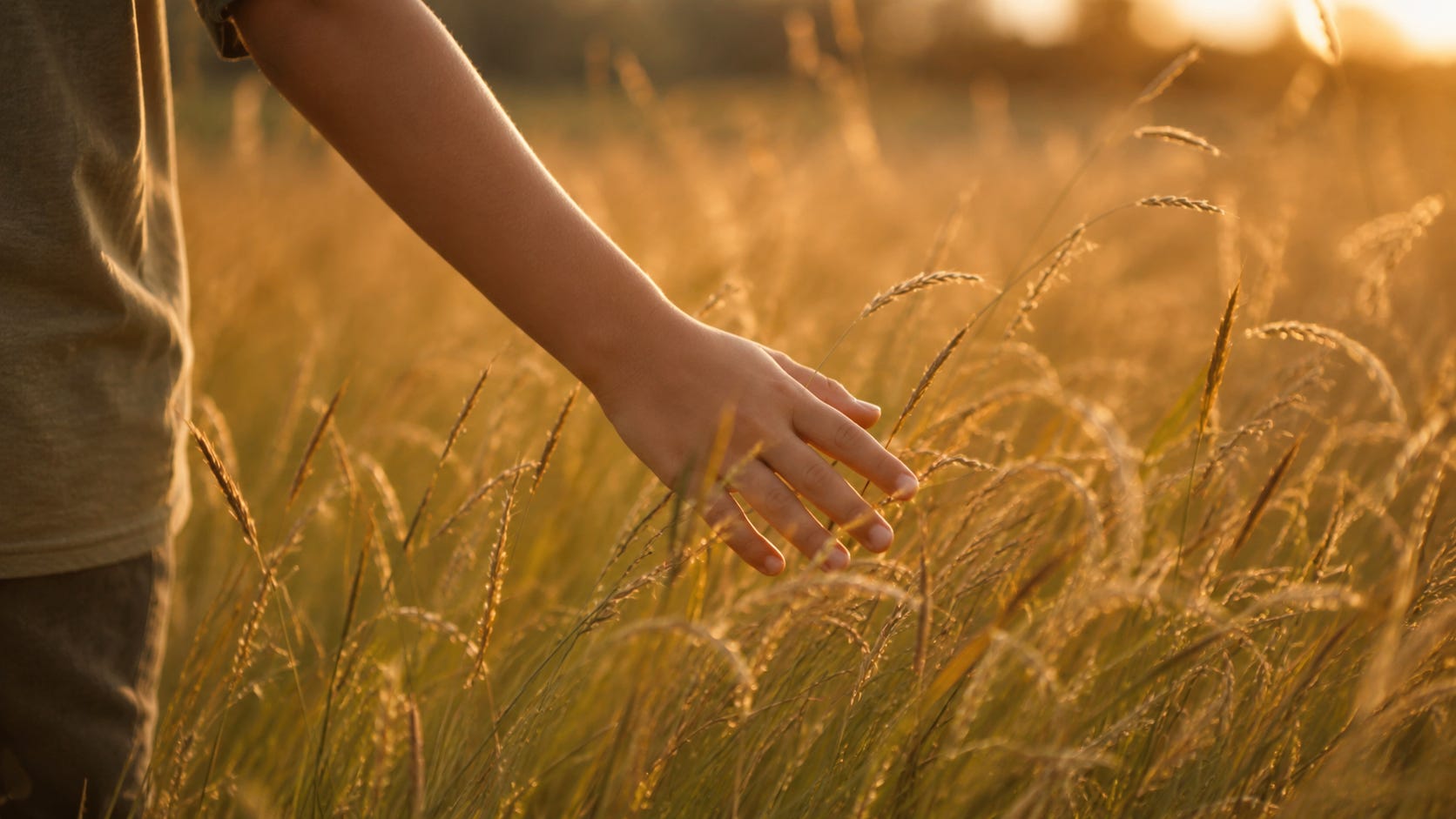
The tall grass grew brown in the summertime. Or perhaps more accurately, it was golden-brown. Armies of stiffened blades swayed and hissed in a wind that rolled unfettered across the hard, flat lands of the far northern state.
My father had a new wife, and she was gentle with me. She tried her best to connect with me, but I’m not sure I knew how—so accustomed was I to the more chaotic forms of motherly love. My mother’s love was a surf zone, violent pulling and tugging that at times left you breathless with affection, drowned in a thrashing and clumsy attempt to convince you not to leave this time. A curious mixture of good intentions and bad results that often made for strange children.
I was one such strange child. I was afraid of everything.
Back home, every bump and bruise had been cause to stop everything and fall into triage mode. My mother over-medicalized life. I didn’t have a sore throat—I had strep. I couldn’t just have an angry red scrape—I had to have cellulitis. This was viral. That was bacterial. Say, ah! Oh, dear—now that’s not good, is it?
The world as an unclean and scary place to me when I arrived at a pale yellow house flanked by golden grass. The tall grass waved and danced, holding on to just enough spring to remain supple and compliant, flexible in a way I hadn’t the slightest idea how to mimic. Nor had I the desire.
My father would tell me to go outside to play. I wouldn’t. Gentle of temper, at least with me, he tried insisting. Kids are supposed to play outside, after all. I wouldn’t. Instead, I’d go on a buck-toothed, high-pitched rant about all the things that were waiting to kill me out there.
“I’ll get bit by a rattlesnake,” I’d say. “Gored by a deer. Stung by a yellow jacket or swarmed by fire ants. You remember that time when I was a baby, and I was sitting, unbeknownst to little old me, on top of a nest of fire ants. They climbed all over me, thick enough you couldn’t see a single inch of skin. Momma had to run over and grab a can of gasoline to pour over top of me to get ‘em off. I almost died.”
Little blue copies of my mother’s eyes grew wide and bug-like, staring up at my dad.
He didn’t laugh.
“That didn’t happen,” he said, shaking his head. “Now go outside.”
I didn’t. For the first bit of summer, he let it slide.
On days when I wouldn’t ride into town with my father, taking long straight country roads to Grand Forks Air Force Base—where I’d stare unblinkingly with my neck cocked at an unnatural angle and my tongue hanging out, hoping to convince the gate guard that my father had a child’s dead body in the back seat—I would stay back with my new stepmother.
I was suspicious of her. Needlessly. Offensively. Every time she’d make something to eat for me or my stepbrother, I’d watch her like a hawk.
“Did you wash your hands?” I’d ask.
Good-naturedly, she’d say she had. She even chuckled at the beginning. I’d watch her cook, too, careful to keep an eye on her supposedly clean hands for any signs of trickery. I was convinced, for some reason that made perfect sense in my addled nine-year-old brain, that she was going to poison me.
She’d try to get me outside as well, though with less fervor and exasperation than the talks from my father would devolve into. She’d tell me about the fun things she and her siblings used to do in the tall grass. They’d go “prairie dogging,” which is to say that a pack of marginally organized children would run about annoying prairie dogs until they disappeared into a maze of underground holes.
I had no intent to go prairie dogging. They were out there, and out there had too many dangerous things: spores and germs and bugs and Lord knows what else. The grasshoppers had wings here, for Pete’s sake. No, thank you. Hard pass. Over my dead and still somewhat malnourished little body.
My father locked me out the next day.
You can imagine how that went over. Panicked and enraged, I hammered little fists against the door. I pulled and wrenched on a handle that wouldn’t give a degree of rotation. Then I saw the blinds of a nearby window move just enough to see my father’s eye. He closed the blinds and went deeper into the house. The door stayed locked.
I paced an anxious circle around the pale house, looking for a way in.
The windows were closed tight. I jogged around back to the small concrete patio and harassed the handle. Nothing. Still locked. I traipsed back toward the front, eyes sliding against the other side of the house. Still nothing. It was a castle with siding, its bridges all drawn up. Only, there was no moat full of alligators. There was only the tall grass and whatever monsters lurked within.
I retreated from the hissing fields and ended up sitting on the small front porch, angry and contemplating the cruelty of my father’s act. Didn’t he know how dangerous it was, locking a small child out on his own like this? Probably didn’t care. What if someone kidnapped me? How would that make him feel?
I traced the gravel driveway with wide eyes and imagined a rusty van screaming down the hard pack, sending a plume of dust into the air as its tires slid to a halt. Two men with masks would pop out the side, while one stayed in the driver’s seat to make a quick getaway. They’d grab me and drag me back to the van, wrestling my little thrashing limbs inside. I shuddered. Add it to the list.
How bad would he feel if that actually happened? How stupid would he look then, locking me out to go play? What a silly way to lose a perfectly good son. I glared out into the tall grass, knees curled up to my bony chest, skinny arms crossed and stacked atop scrawny legs. I sat there for a long while. Eventually, I grew bored.
I paced some more circles around the yellow-sided house, these ones slower and more curious. I stopped looking for ways to breach the airtight fortress and, instead, began to just look at things. I saw places where individual pale planks were trying to pull away from their stacked companions, the beginning of a rebellion against the house’s edifice. I saw gaping maws of wire-covered vents for who knows what, yawning mouths only partially prepared to keep the largest of critters out. There was a cantilevered basement door, which I gave a wide berth—having not the slightest idea or interest in what kind of thing could lurk within. I was bored, I wasn’t crazy.
Eventually, I grew bored with the laps, too.
I sat back on the concrete steps and reexamined the tall grass, just beyond the mowed space, making a low, neat perimeter around the house. I stood up and walked out close to the perimeter. I’d take a deep breath, but each time I’d work myself up enough for my first foray out into the stuff—with all the intensity and melodrama of a non-swimmer preparing himself to dive down deep into dark water—I’d see something move. Then I’d lose my nerve, running and screaming back to the concrete steps, where I assumed the door was still locked.
Then, one time, I made it out into the tall grass. It wasn’t far, and it wasn’t long, but I breached the skin of the golden-brown barrier and plunged into its depths at a dead sprint, fists knuckled for the briefest of moments. Then I was running back to the steps, breathing like a steam engine and looking over my narrow shoulder at the organized band of rattlesnakes that, having taken notice of my reckless act, were giving pursuit—or the flights of grasshoppers and yellow jackets who had formed a temporary alliance and were swarming my way at that moment to drop platoons of deadly fire ants upon me. Only this time there’d be no life-saving gasoline and—
And nothing happened.
I worked up the nerve to venture out again—this time a little longer and a little farther. I ran hard, hands stiff but open, brushing against golden-brown stalks that seemed to lean into me, laughing in the North Dakota breeze. They didn’t seem to be hissing anymore. It sounded more like a thousand—no, a million—collective sighs. A part of me sighed along with them.
And I felt the weight of a world turned too heavy slough off of too-narrow shoulders for a time. It was a temporary relief, to be sure, but it was real, and it was kind. I could breathe, and I could run. I could laugh, and I could play. And the world felt childlike for a handful of merciful weeks.
I ran tall and fast out deep into the tall grass for I don’t know how many days that summer. But I know they were too few for my liking. I know that the summer grew short faster than I would’ve liked and, before I knew it, I was back in Kentucky and winter was setting in. The cold, ugly kind that climbs deep into your bones without any promise of things like white winters. And the world grew heavy again.
Sometimes life is like that, though. Not all the world can be blanketed in tall grass. But a locked door can be a way out on occasion.
Happy Father’s Day, you old goat. And thank you for caring about me.
Wow. Thank you for this. Touching and genuine. Beautifully written.